
Iron County Deed Records Begin With the Recorded Instrument
Every Iron County land document starts at the Recorder's counter. That office records deeds, mortgages, liens, and plats, then indexes each one for public access. A deed shows a transfer as presented. It does not certify perfect title. Compare the legal description, the named parties, and the recording reference against the Assessor account. Draw conclusions only after that check. A deed's label alone never tells you the instrument's full legal effect.
| Deed Type | What It Does | Common Use |
|---|---|---|
| Warranty deed | Conveys the interest described with the deed's stated covenants | Review a recorded conveyance; read the instrument terms |
| Quitclaim deed | Transfers whatever interest the grantor may have | Family or title-cleanup transfers |
| Grant or special warranty | Conveys an interest under the warranties stated in that deed | Compare the recorded language with the transaction |
| Trustee or executor deed | Shows a transfer signed in a fiduciary role | Estate, trust or other authorized transfer |
| Tax deed | Records a conveyance associated with a tax process | Read with the underlying proceedings and title review |
Mortgages and liens belong to a different record family than deeds. A lien may affect land without conveying title. The Recorder's holdings include both. So scope each Iron County property search to the actual question: transfer history, a security instrument, a lien notice, or a plat. Chasing past owners instead? The former-owner chain guide walks backward through recorded parties step by step.
Tracing Iron County Grantor and Grantee Names
Start with the current Assessor account. It lists the owner of record and legal description. From there, use the Recorder's land-document search to pull the latest deed. Field labels and the earliest online year vary by portal. Follow the live prompts on screen. Name queries often return several matches. The Recorder can say which entry fits your parcel. The county publishes no confirmed online cutoff, so treat any assumed date range with care.
- Find the latest deed for the property and note the grantee, grantor and recording reference.
- Use the prior grantor as a name to locate the deed by which that party acquired the parcel.
- Compare each legal description and instrument reference before treating two results as the same land.
- For documents not online, ask the Recorder about its index and copy options; no verified portal start year is published in this research.
- Grantor
- The party conveying an interest in the instrument.
- Grantee
- The party receiving the interest stated in the instrument.
- Chain of title
- The sequence of recorded transfers used to trace ownership over time.
- Recording reference
- The Recorder's document identifier; confirm the format on the actual index result or copy.
Requesting an Iron County Deed Copy
Not every deed image is online. The Recorder links property accounts and land-document resources but publishes no confirmed image cutover. When a document stays out of reach, call the office. Staff will want the parties' names, the approximate recording date, and a parcel account or legal description. Fees are modest. A recorded-document copy costs $1. A Xerox copy is $0.10, and a certificate under seal is $5. Reach the Recorder at 68 S 100 E, PO Box 506, Parowan, UT 84761, or call 435-477-8350 to confirm the current fee.
Recorded, not guaranteed. An index is evidence of what the Recorder accepted, not a title opinion. The office does not interpret documents or perform title searches; use a qualified title professional for a full ownership examination.
Iron County's Recording Checklist Shapes a Deed Search
The Recorder's checklist shapes every land instrument. Original signatures and notarization come first. A legible legal description and serial number follow. A grantee mailing address is required when the document conveys property. Margins matter too. The first page reserves a stamp area 2.5 inches down and 4.5 inches across at the upper right, and later pages need a one-inch bottom margin. These are filing-preparation details, but they explain why an instrument may skip a street address entirely. Knowing that makes a parcel search easier.
Copy names exactly as the index shows them. Then compare the legal description line by line. A missing middle initial, entity suffix, or parcel phase can pull a search toward the wrong record. If the document covers several lots, note the count. The county adds $2 for each lot or description over ten when calculating recording fees.
Iron County Deed Recording and Copy Fees
Recording a new document costs $45 under the schedule effective May 6, 2026. A subdivision plat is $55 per page plus $2 per lot or unit. Plats have their own price list. An 18-by-18-inch ownership plat costs $3. A 24-by-36-inch official plat is $5, and a county map is $5. Copies are separate. A recorded instrument copy runs $1. A Xerox copy is $0.10, and a certificate under seal is $5.
Fees can change. Confirm the current amount and accepted payment method with the Recorder before mailing anything. For deed records, give staff the party names, legal description, and date range; never mail an original just to ask whether it is indexed. The Recorder's page links checklist, fees, and contacts together.
Recorded Plats and Ownership Plats Are Separate Iron County Records
Iron County keeps its plat collections in separate repositories. The Recorder links one SharePoint repository for recorded plats and another for survey plats. Ownership plats do other work entirely. They show ownership, acreage, the parcel address, the taxing units and the owner address. They also support assessment and tax collection. A plat can clarify how a deed's legal description maps to a lot, block or parcel. It is still not a title report.
Download access is uneven. The county's file navigation does not open every plat sheet directly. Treat what can be pulled online as uncertain. The Recorder can identify the right plat and the copy type for a request. Iron County sets separate prices for ownership plats, official plats and county maps. The formats and uses differ. Knowing that saves a call. An address search and a deed description may seem to point to different land. Compare the lot and legal description on the recorded plat.
The Iron County Recorder's land-record page links to each document and plat repository.
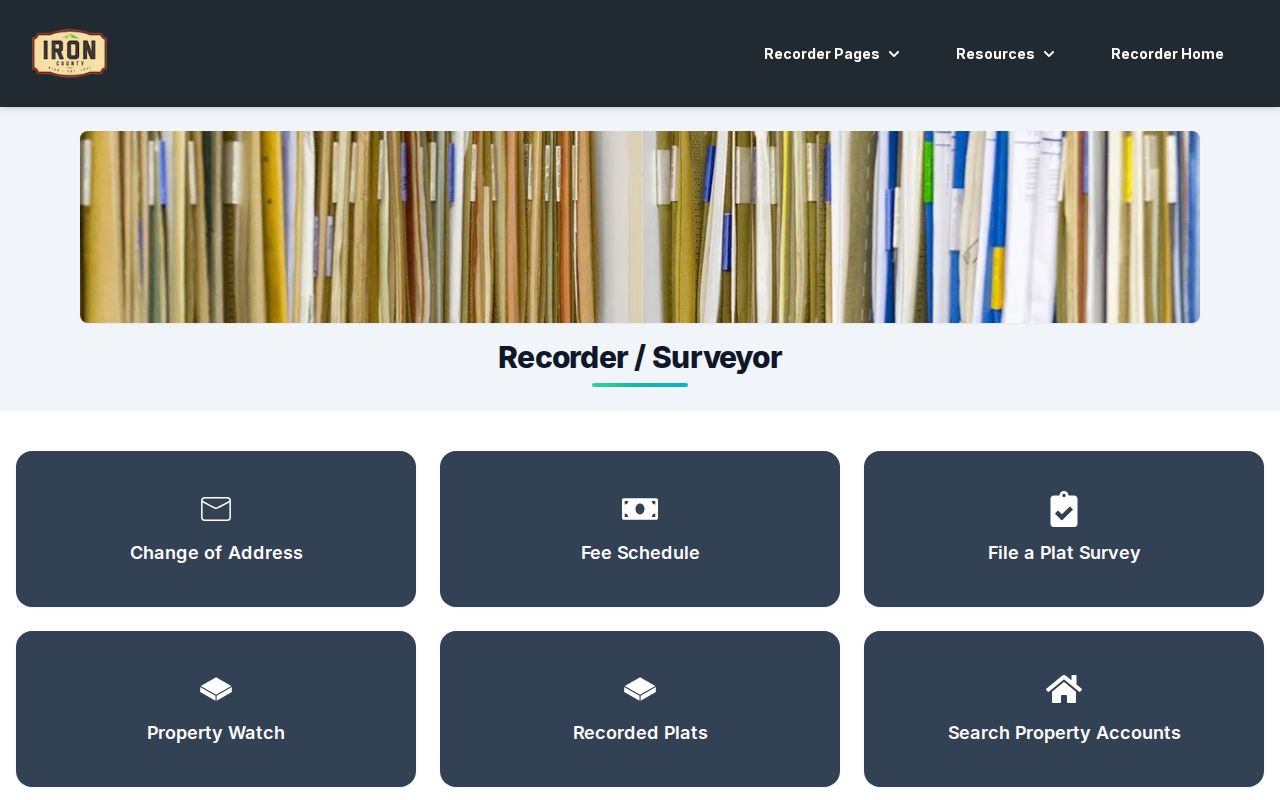
Use the official Recorder page as your index. Then ask the office about any plat or copy that will not load.
Property Watch Adds a Deed-Alert Layer
Iron County offers a free Property Watch or Fraud Guard signup through the Recorder's online resources. Think of it as an alert layer. It flags activity tied to a name or property. The service does not prevent a filing. It cannot certify that a deed is valid, and it never replaces review of the recorded instrument. A notice should push the owner of record to check the actual document. Contact the Recorder if a filing looks unfamiliar. The county publishes no details on the signup fields or alert timing.
An alert works best alongside other records. Pair it with the index reference, the instrument image and the parcel account. Keep the record number and date. Confirm the details with the office that holds the deed, because a name match alone does not prove a filing concerns the right parcel. The legal description is the stronger cross-check.
Cedar City Construction Notices Complement Iron County Deed Records
Cedar City points researchers to Utah's Construction Registry for project notices. The public search route is simple. Choose Public Search Functionality. Then select Cedar City or Iron County as the issuing municipality. Leave the other fields blank to broaden the results. This can surface construction notices tied to a project. It complements a check for recorded mechanic's liens with the Iron County Recorder. The instruction is city-specific, so do not generalize it to every municipality in the county.
The registry and the deed index answer different questions. A registry notice may surface before any lien document appears in the deed index. Record the project, parcel and issuing municipality. Then ask the Recorder for the instrument actually recorded against the land. A portal that returns no match does not mean no notice exists. Check the appropriate system and ask the custodian about its coverage.
Start with the city's own steps. The Cedar City construction-registry instructions walk through the municipality selection.
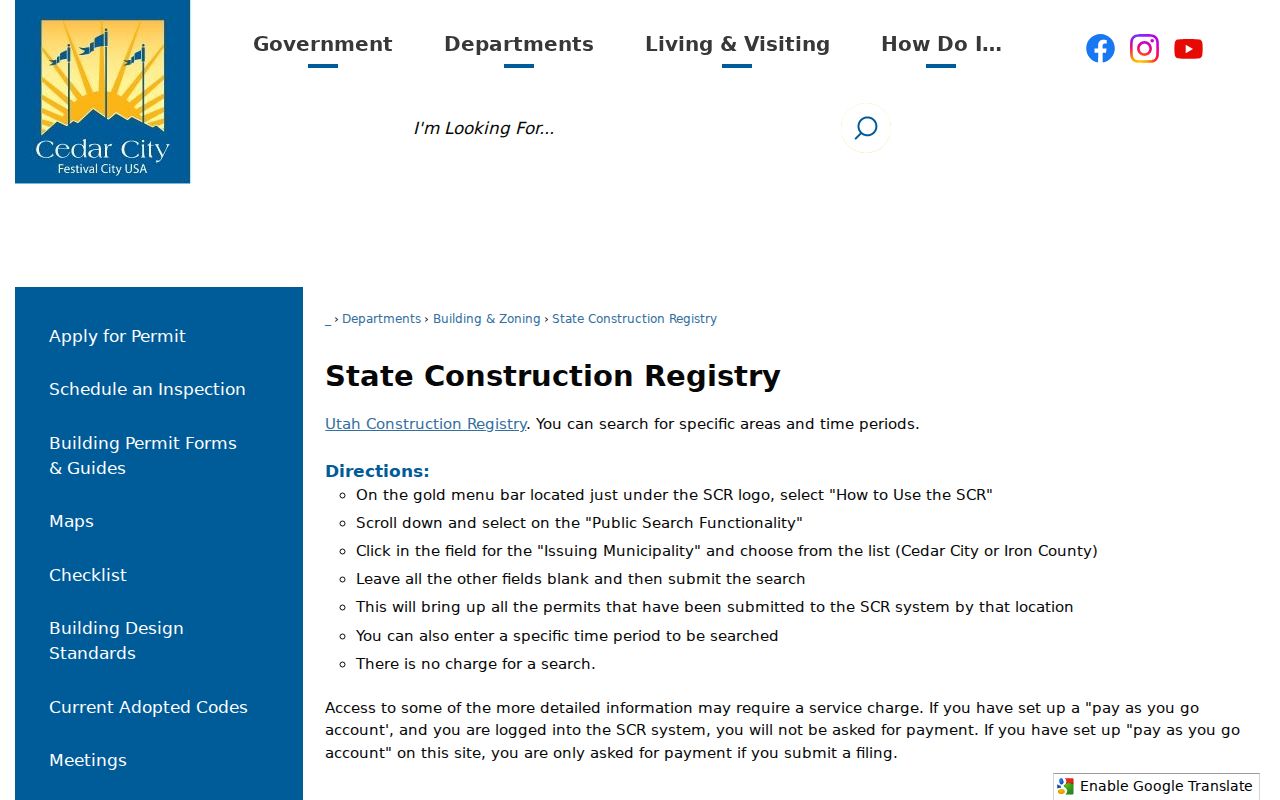
Check notices here; verify deeds with the Recorder.