
What an Iron County Tax Record Actually Shows
Every Iron County tax record really holds two ledgers. The Assessor's valuation record classifies property and sets value. That office never collects a dime. The Treasurer's side handles the money, publishing delinquent lists, processing payments, and distributing tax revenue to local units. It cannot change a value, grant an exemption, or decide an appeal. Context matters when reading each field. An appraisal figure on the assessment roll and an amount due on a tax bill are different numbers with different meanings.
| Field | What It Shows | Where |
|---|---|---|
| Assessed value | The Assessor's value for the annual roll | Assessor / EagleWeb |
| Market value | The Assessor's estimate of fair-market value | Assessor / EagleWeb |
| Taxable value | The amount after any applicable assessment ratio or exemption | Assessor account and tax calculation |
| Tax bill and status | Amount billed, payment and delinquency information | Treasurer / BillTrax |
| Taxing districts | The jurisdictions or units included in the parcel's tax | Assessor record and Treasurer account |
The Assessor's fair-market figure is an estimate. It comes out of the office's valuation process. It is not a promise that the parcel will sell for that amount. Taxable value often sits lower. An assessment ratio or an allowed exemption can shrink the base. The Treasurer's bill then applies that taxable amount plus the local levies. A recently recorded sale price is separate evidence. It may post to the roll after the January 1 snapshot that fixes each year's figures.
January 1 Fixes the Iron County Assessment Snapshot
January 1 anchors Iron County's assessment calendar. Ownership and condition freeze as of that date. A sale recorded in June may not reach the tax roll until the next cycle, leaving a temporary mismatch between the newest deed and the owner of record. The gap is timing, not a broken chain of title. Compare the Recorder's deed with the Assessor account when tracing a purchase, and never treat a tax statement as title proof.
The county's published calendar fills in the rest. The assessment roll closes May 22. Valuation and tax notices arrive around July 22, and August brings the Board of Equalization review period. Appeals must land by 5 p.m. on September 15. Tax notices go out November 1, and payment is due November 30. Those dates come from county explanatory material and can shift, so rely on the date printed on the parcel's current notice.
Iron County's 55 Percent Primary-Residence Example
Iron County's Assessor offers a worked example: a primary residence taxed at 55 percent of its fair-market value. The taxable portion is the smaller number. It is not the market estimate itself. That distinction trips up many readers comparing an assessment record with a tax bill, because one shows market value while the other reflects the taxable base actually used in the calculation. Class and qualification drive the result. Not every home gets the same treatment.
The county links a Residential Questionnaire for primary-residence claims. Value questions go to the Assessor. If a record shows the wrong classification, ask which form and supporting evidence the office requires. Fixes start with the right paperwork. The county does not publish a full exemption list or an online application workflow here, so confirm directly what relief exists before assuming a reduction.
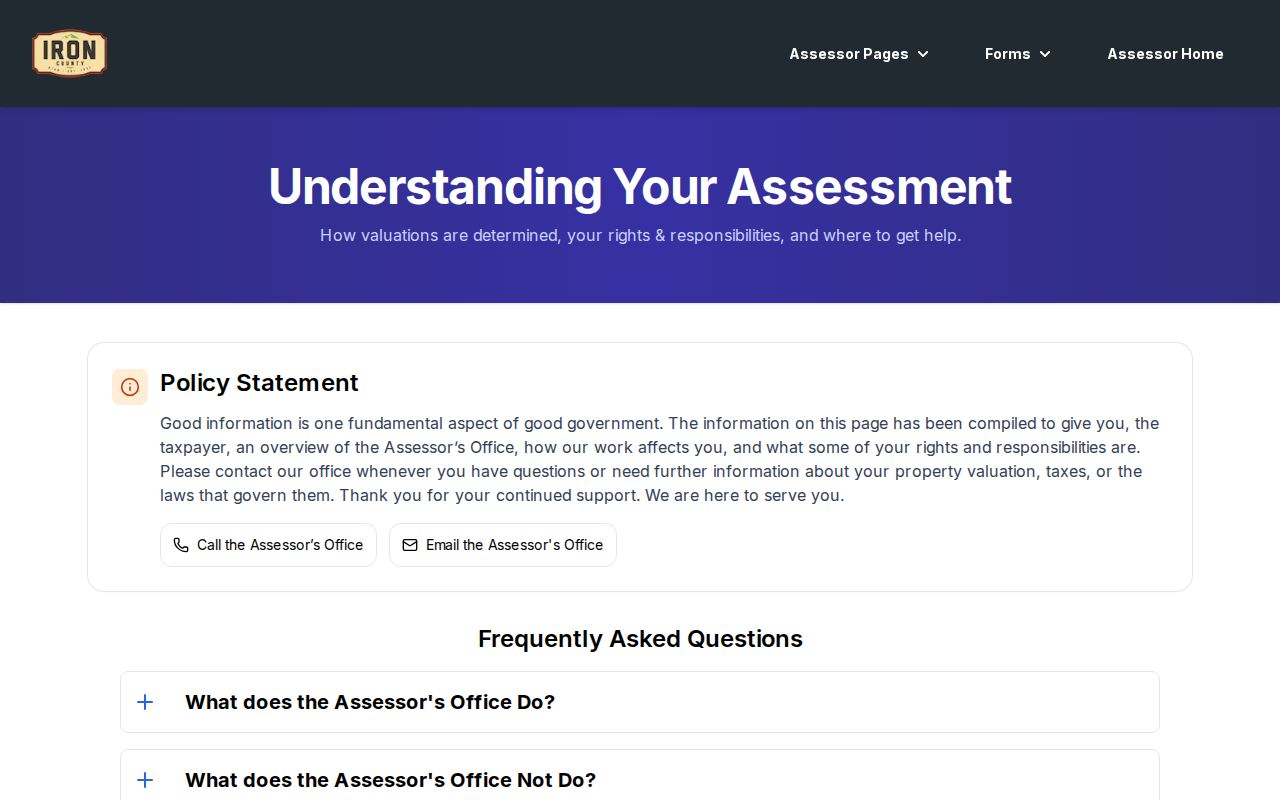
For the distinction between assessed and taxable figures, the Assessor's value and appeal explanation lays out the office's own approach. It is worth a read before any appeal.
Confirm the example against the parcel's current notice.
Finding an Iron County Tax Bill and Payment Status
The Treasurer offers two tools for tax accounts: a property-account search and BillTrax, its payment and tax-notice service. Start with the parcel address or account details. Two results can look nearly identical. Before paying or requesting a correction, compare the legal description and taxing district to be sure you have the right parcel. BillTrax runs on JavaScript. Its field names can change with the application, so follow the prompts on screen instead of expecting a specific search box.
- Open the Treasurer's BillTrax link or property-account search.
- Match the bill to the parcel account, situs and tax year shown by the system.
- Read the amount due and posted payment status on the Treasurer's service.
- Contact the Treasurer if a bill or payment cannot be matched to the right account.
- Assessed value
- The Assessor's annual value determination for the parcel.
- Taxable value
- The amount used in the tax calculation after applicable rules.
- Levy
- A taxing unit's rate applied under the current tax calculation.
- Tax delinquency
- An unpaid tax status handled by the Treasurer under the current notice and law.
The BillTrax tax service is the county's online payment and tax-notice application.
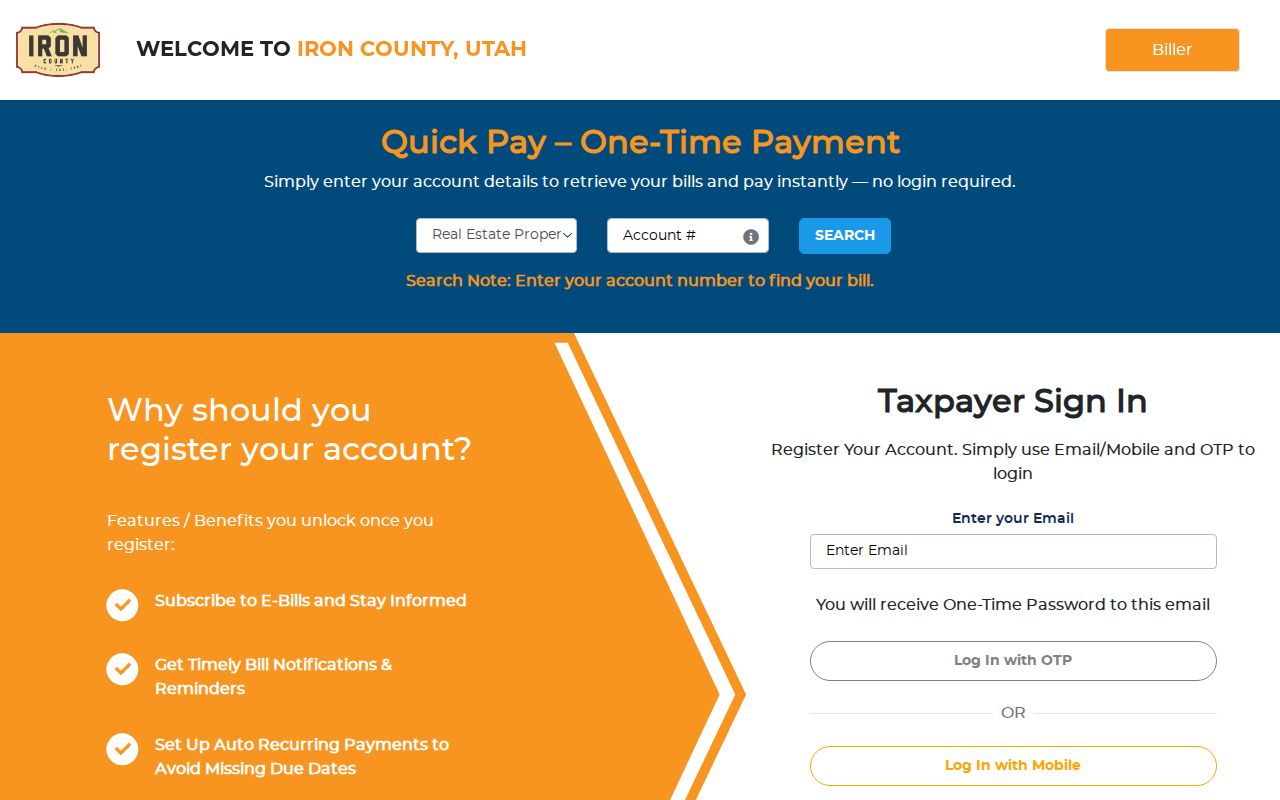
The application is the payment layer; valuation and classification questions belong with the Assessor.
Iron County Tax-Rate Examples Are Historical
The Assessor's page lists 2021 rate examples for five communities. Cedar City shows 0.008045, Enoch 0.007566, Parowan 0.008324, Paragonah 0.006802 and Kanarraville 0.007513. The county labels these figures historical. Any of them could differ today. A city rate is not the whole bill. The calculation can pull in more than one taxing unit. So read the current statement for the parcel's actual districts and amounts.
Place names can mislead too. A postal address may carry a nearby city's name. But the taxing district can point somewhere else entirely. The GIS boundary and the account's district fields show which local rate components actually apply. When a bill looks wrong, call the Treasurer. Give the account number and ask how the current district assignment was made.
Use the Current Iron County Delinquency Notice
A 2025 Treasurer notice set the rules plainly. Taxes paid after December 1 were delinquent. The penalty was 1 percent, with a $10 minimum per parcel, and additional penalty and interest applied to anything still unpaid by January 31, 2026. The Assessor's separate calendar gives November 30 as the due date. The two figures come from different published materials. They may not describe the same tax year. Rely on the current parcel bill and the Treasurer's latest delinquency notice for any payment decision. Never carry an old notice's dates onto a new tax year without checking.
The Treasurer publishes delinquent-tax lists annually and processes payments and refunds, but it does not decide assessed value, exemption eligibility or assessment appeals. Payment questions go to the Treasurer. A value dispute belongs with the Assessor, following the notice's appeal instructions.
Contesting an Iron County Assessment
An owner who disagrees with an Iron County assessment has a formal route. The Assessor's annual material allows an appeal to the Board of Equalization. The deadline is September 15 at 5 p.m. Start with the valuation notice and the county's current appeal instructions. Check the parcel identity first. Then review the value components before gathering evidence. Strong evidence speaks to market value or to a factual error in the account. It should connect to the property and the valuation date. The Assessor relies on cost, income and market approaches. A tax bill alone does not prove an assessment wrong. A late request may simply miss the window. Contact the Assessor about the form, supporting materials and the current deadline before filing. The Board's rules control what is accepted.
Appeal window. The published county calendar gives September 15 at 5 p.m. for the Board of Equalization appeal. Confirm the date and submission steps printed in the current notice before relying on that calendar.
Follow the Iron County Assessment and Tax Calendar
Iron County's tax year unfolds in stages rather than on one date. January 1 is the snapshot date. Ownership and condition count as of that day. The assessment roll is due May 22. Valuation and tax notices are scheduled for July 22, and the Board of Equalization meets in August. The Assessor's appeal deadline is September 15 at 5 p.m. Tax notices come again November 1. November 30 is the due date. That sequence explains why a value question, an appeal and a payment question can land in different offices months apart.
Trust the date on your current notice. It controls over a general calendar or an older page. A July valuation notice can prompt an appeal. The later tax bill is the payment record, and keeping the notice, parcel account and proof of payment together helps the Treasurer or Assessor identify the right year and account. The calendar gives a useful sequence, but it does not replace the directions on an individual notice.
Ask the Iron County Office That Controls the Tax Record
Iron County splits the tax record between two offices. The Assessor values parcels and maintains assessment information. The Treasurer bills, collects payments, processes refunds and publishes delinquent-tax lists. Neither office answers for the other's work. Paying a bill settles no value dispute. Winning an appeal does not confirm that a particular bill was paid. So ask the office that owns the record. Include the account number, the tax year and the exact notice or field that prompted the question.
The Treasurer's public counter sits at 68 South 100 East in Parowan, PO Box 369, with a listed phone of 435-477-8360. The Assessor is at PO Box 537 in Parowan. Its listed hours are weekdays, 8 a.m. to 5 p.m. Hours and service details change, so verify them before traveling. A focused request for one tax bill, payment history or valuation notice is easier to route than a broad request for all property information.